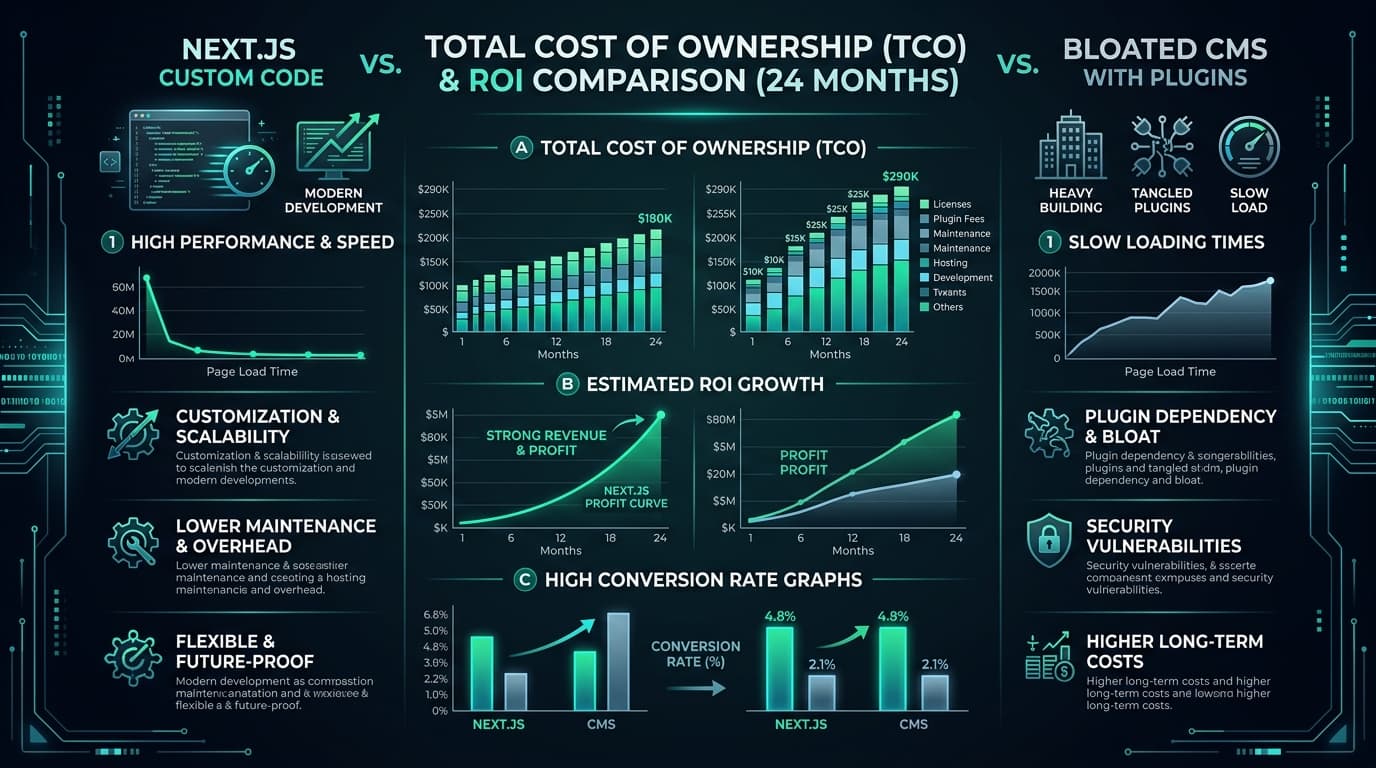

Effective SEO is no longer just keywords. It is the synergy of Next.js 16 architecture, Core Web Vitals performance, and content that Google and AI models can both understand. At LykKreacji we build premium sites that rank — and sell.
Traditional ranking tactics cannot keep up with AI-driven search or users who expect instant page response. Combining the App Router, React Server Components and an AI-oriented architecture defines a new class of premium sites: visible in Google, cited by answer engines, and built to convert.
Next.js SEO premium and the App Router foundation
Visibility starts with a fast, stable stack. Next.js 16 and a mature App Router — together with React Server Components — end the era when crawlers had to wait on Client-Side Rendering. Classic CSR delayed indexing and wasted crawl budget. In a modern stack that problem disappears.
- Crawlable HTML from the first millisecond: with SSR, SSG and ISR, bots receive semantic HTML without waiting for JS. RSC and streaming complete the model — browser and crawler see content immediately.
- Partial Prerendering (PPR): a static shell loads instantly while personalised data streams in asynchronously. For SEO that is a strong speed signal; for users — no perceptible delay.
Shipping App Router SEO with Next.js makes your site structure transparent to indexing algorithms — without the compromises typical of heavy CMS platforms.
Metadata API and structured data
Precise metadata is the baseline for talking to search engines. The Metadata API in Next.js 16 lets you manage tags dynamically with full TypeScript support — without risky <head> hacks. You define them in layout.tsx and page.tsx:
import type { Metadata } from 'next';

export async function generateMetadata({ params }): Promise<Metadata> {
  const product = await getProduct(params.id);
  return {
    title: `${product.title} - Premium Solution | LykKreacji`,
    description: product.excerpt,
    openGraph: {
      images: [product.coverImage],
    },
  };
}
Beyond title and description, JSON-LD for rich results plus framework-generated sitemap.xml and robots.txt remove human error and keep technical architecture consistent from day one.
AI in SEO: GEO, AEO and content negotiation
Classic SEO is giving way to AEO (Answer Engine Optimization) and GEO (Generative Engine Optimization). Premium sites must work not only in Google but also for AI parsers — OpenAI Search, Perplexity, Gemini — that answer users directly.
1. Generative Engine Optimization and llms.txt
We implement content negotiation for LLM agents: specialised data structures and the llms.txt standard at the site root. The file describes your offer architecture without noise. Language models can then cite your brand more accurately as a knowledge source.
2. Programmatic SEO and MCP agents
Agents built on the Model Context Protocol (MCP) support purchase-intent analysis and automation around Google Business Profile. On Next.js we run programmatic SEO — unique landings for niche queries at a scale that classic CMS setups struggle to maintain.
“Premium SEO in 2026 is App Router, Core Web Vitals and AI-ready content — not a keyword list in a paragraph.” — LykKreacji team
Performance and Core Web Vitals
Google penalises slow sites. LCP and INP (Interaction to Next Paint) are direct ranking factors. For premium Next.js sites we use the framework’s native optimisations:
| Component / mechanism | Core Web Vitals benefit | SEO impact |
|---|---|---|
| next/image | WebP/AVIF, lazy loading, less CLS | Faster render, stronger image search signals |
| next/font | Self-hosted fonts without layout shift | Better LCP and visual stability |
| Automatic code splitting | Only the JS each page needs | Shorter time to interaction (INP) |
Strong performance lowers bounce rate and sends a positive behavioural signal — users stay instead of returning to the SERP.
From visibility to revenue
Top rankings without conversion do not grow a business. At LykKreacji we treat technology as a revenue tool: organic traffic should flow into leads and sales.
A Next.js 16 app removes funnel friction — no full reloads, UX close to a native app. Speed plus AI-precise content matching lifts conversion on premium-class sites.
Considering the investment? Check website pricing or estimate returns in the ROI calculator. Case studies live in the LykKreacji portfolio and on the blog.
Frequently asked questions
How do GEO/AEO differ from classic SEO?
Classic SEO targets organic Google rankings. AEO optimises for answers (featured snippets, voice, AI Overviews), and GEO for citations in generative engines. A premium site should cover all three layers.
Why implement llms.txt?
llms.txt is a concise map of your offer and architecture for AI agents. It helps models understand brand context and improves the chance of accurate citations in generative answers.
Does Partial Prerendering help SEO?
Yes — bots and users get a fast, ready HTML shell while dynamic fragments load without blocking first paint. That supports Core Web Vitals and crawlability at once.
Ready for a tech edge that pays off?
Let’s talk Next.js 16, AI SEO and a premium site tailored to your industry. The first step is a short consultation.
Contact us