


1. What Are Server Components?
Traditionally, all of React rendered in the browser (Client-Side Rendering). Server Components render on the server, sending only ready HTML to the browser.
Difference between Client and Server Components:
| Aspect | Client Component | Server Component |
|---|---|---|
| Where it renders | Browser | Server |
| JavaScript Bundle | Large (full code) | Zero (HTML only) |
| DB Access | No (API only) | Yes (direct) |
| Interactivity | Yes (useState, onClick) | No |

2. When to Use Server Components?
The rule is simple: use Server Components by default, and Client Components only when you need interactivity.
✅ Use Server Component for:
- Fetching data from a database (Prisma, SQL)
- Displaying static content (blog, products)
- Using secrets (API keys) – safely on the server
- Large libraries (markdown parsers, image processing)
✅ Use Client Component for:
- Forms (onChange, onSubmit)
- Animations (Framer Motion, GSAP)
- useState, useEffect, useContext
- Event listeners (onClick, onScroll)

3. Practical Example: Blog with RSC
Traditionally, a blog in React required:
- Fetch data from an API (fetch in useEffect)
- Show a loading spinner
- Render the data
- Send the entire React bundle to the browser (~200kB)
With Server Components:
// app/blog/page.tsx (Server Component)
async function BlogPage() {
  // Direct DB query – on the server!
  const posts = await prisma.post.findMany()

  return (
    <div>
      {posts.map(post => (
        <Article key={post.id} post={post} />
      ))}
    </div>
  )
}
Result: The page loads instantly, without JavaScript, without loading spinners!
4. Streaming and Suspense
RSC enables streaming – sending HTML in chunks as it becomes ready:
<Suspense fallback={<Skeleton />}>
  <SlowComponent /> {/* Renders async */}
</Suspense>
Users see the page immediately, and slow components "load in" in the background.
5. Business Benefits of RSC
- SEO: Google sees full HTML instantly (no waiting for JavaScript)
- Performance: Core Web Vitals 100/100 with minimal effort
- Costs: Less server load (edge caching)
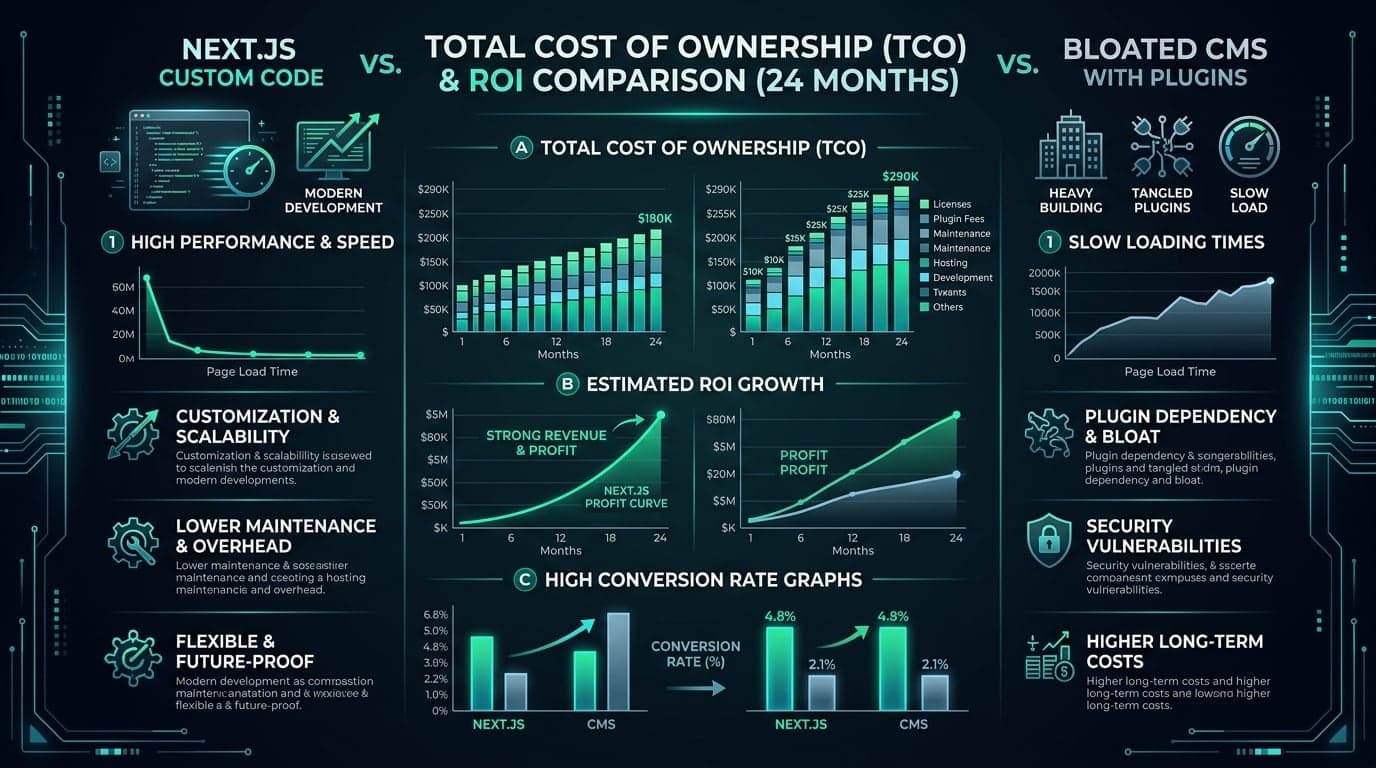
- UX: Instant loading = higher conversion
Summary: Server Components are the future of React. Companies using Next.js 13+ with RSC have an edge in speed, SEO, and costs. Time to migrate!
Ready to implement this in your project?