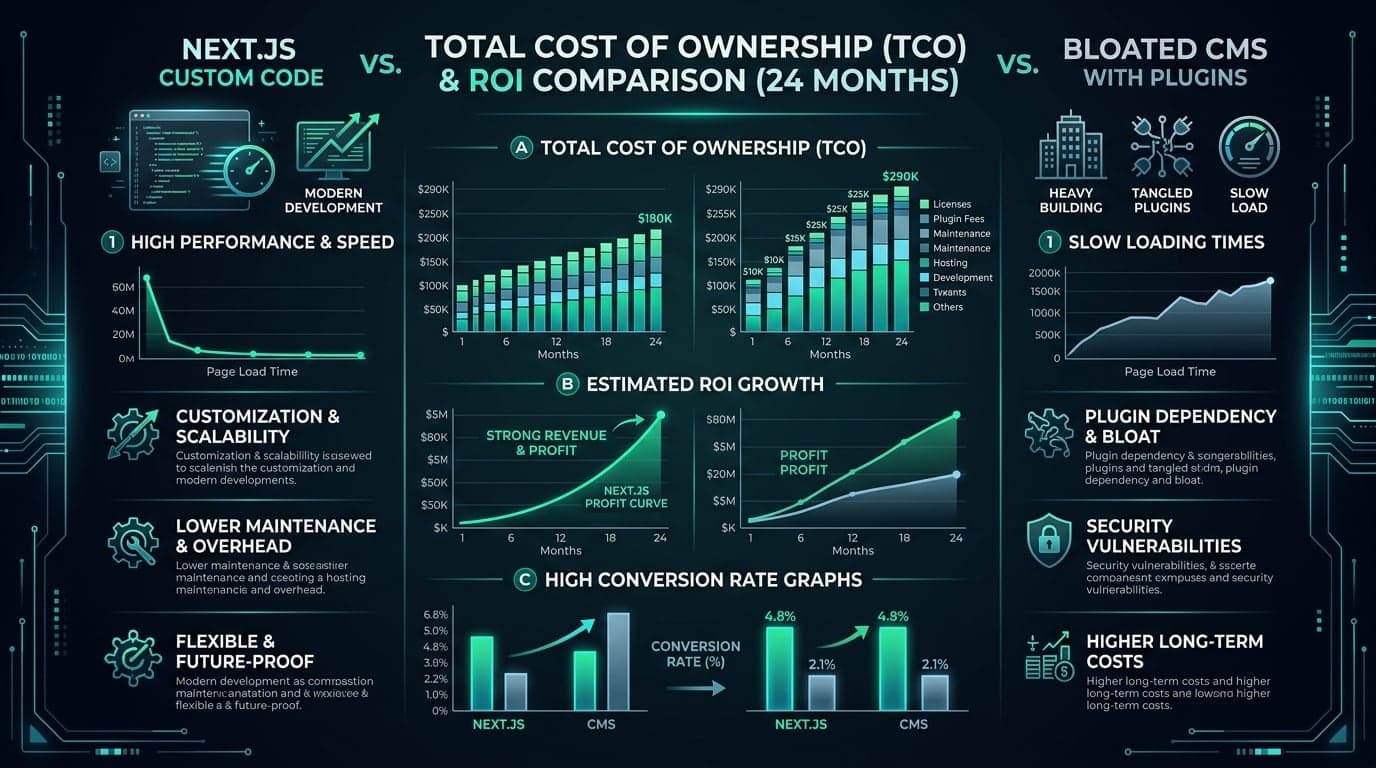



Technical Debt: WordPress Hidden Costs
WordPress, though popular, carries risks that become expensive over time. This is so-called technical debt that you pay off every month of use.
Lost Conversion: The Price of Slow Loading
- Fact: Every second of page load delay can reduce conversion by up to 20%.
- Analysis: Average load time for a WordPress site (burdened with plugins) is often 3–5 seconds. In that time you lose customers who simply won't wait and go back to Google.
- Calculator: You don't have to guess. Our tool lets you precisely calculate how much money you lose annually because of a slow site.
Security Risk and Constant Updates
Plugins are the main source of security vulnerabilities. Constant updates are necessary but often lead to crashes and conflicts ("White Screen of Death").
Cost: It's not just stress – you need to pay a specialist for regular maintenance, bug fixes, and backup restores.
SEO and Performance Limitations
Google increasingly rewards sites that are fast and stable with Core Web Vitals. WordPress, with its decade-old architecture, struggles to achieve top scores without aggressive caching (which often breaks functionality).
Conclusion: Your site cannot compete effectively in search results, drastically limiting your free organic traffic.
Next.js: An Investment That Pays Off in Conversion
Moving to a modern architecture is not a cost – it is an investment in a revenue-generating machine.
Unbeatable Speed and SEO
Next.js sites achieve 95–100/100 in performance tests and load in milliseconds. This translates directly into:
- Lower bounce rate.
- Higher conversion (more sales with the same traffic).
- Better Google rankings (free traffic).
Security and Scalability
SSG/SSR architecture means no database exposed to the world (Headless). This eliminates most threats typical of WordPress (SQL Injection). The site is also ready for any sudden traffic spike (e.g. from ads or viral content) without server crash risk.
Summary: Stop Losing, Start Earning
Technology choice is a strategic business decision. Can you afford for your site – your main showcase – to generate losses instead of profit?
Don't guess how much you're losing.
Use our Valuation Calculator and compare WordPress vs Next.js costs in the context of potential revenue.
Calculate Your Next.js Profit
Further reading:
[1] Google web.dev — Why Speed Matters
[2] LykKreacji — Core Web Vitals & INP in 2026
[3] LykKreacji — WordPress → Next.js migration case study